Empathetic People Can Read Minds and Know When You're Lying Meme
The surprising downsides of empathy
(Image credit:
Getty Images
)
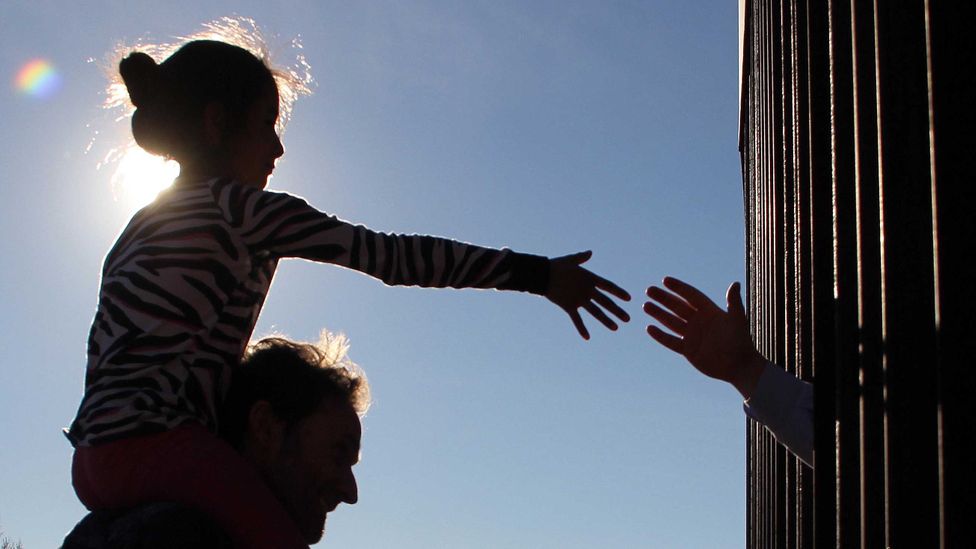
There's a night side to feeling the emotions of other people. In some cases, information technology can even lead to cruelty, assailment, and distress.
O
On CBeebies, the BBC service for little children, in that location's a programme called Treasure Champs, which aims to teach immature viewers well-nigh their feelings, and how to manage them. In one episode, the character Barry – a blue rectangle with pink eyebrows – is glum well-nigh the effect of his football friction match.
"We lost," says Barry.
"It doesn't matter!" says Kari.
"It was my fault. I let all the goals in."
"I don't understand why you're so distressing. Just forget about it."
"I tin't."
"Why not? It's merely a game."
"You're non showing a lot of empathy, Kari. It means putting yourself in someone else'due south shoes."
"Your shoes won't fit me, Barry."
As definitions get, Barry'south i seems a pretty good one for empathy – it's about projecting yourself into somebody'south mind to experience what they feel. And equally the episode goes on to tell its young audience, agreement other people'due south feelings is of import.
In the developed world, however, the virtues of empathy are less articulate. Every bit the pandemic pushes the states into isolation, culture wars rage, and disinhibited cruelty brews on social media, it feels a little controversial to suggest that empathy has downsides. All the same in contempo years, researchers have found that misplaced empathy can exist bad for you and others, leading to exhaustion and apathy, and preventing you from helping the very people you need to. Worse, people'south compassionate tendencies can even exist harnessed to manipulate them into aggression and cruelty. So, if not empathy, what should we aim to feel instead?
You may too like:
- What makes people finish caring?
- How feeling bad changes the brain
- A new way to wait at emotions – and how to principal yours
The word empathy comes from the German word "Einfühlung", coined in the late 1800s, which might broadly translate as "feeling into". But as psychologist Judith Hall of Northeastern Academy wrote in Scientific American last month, "empathy is a fundamentally squishy term". Some run across it as the power to read their fellow human beings, or simply feeling continued to people, while others see it as more of a moral stance about showing business organization for others. Even researchers disagree when they are studying it.
Still, "despite the conceptual squishiness, most people view empathy as having something to exercise with understanding what other people are going through and beingness concerned about them", writes Hall.

The Covid-19 pandemic has tested our ability to sympathise with strangers (Credit: Getty Images)
Paul Bloom, a psychologist at Yale University, defines empathy specifically as the deed of stepping into someone's mind to experience their feelings – and information technology's this that he takes issue with. "Even in this narrow sense, empathy might seem like an obvious force for good. Common sense tells us that experiencing someone else's pain will motivate united states to intendance about and help that person," he writes in the periodical Trends in Cognitive Sciences. However, it leads to some catchy moral dilemmas.
To illustrate why, Bloom tells the story of a ten-year-old girl called Sheri Summers, who has a fatal affliction. Doctors have placed Sheri on a waiting list for a handling that will relieve her pain, and potentially prolong her life. Sadly, this very bright, very brave girl learns she has weeks or months before that happens.
Imagine how that feels, and how it volition affect Sheri's life. What would you lot exercise if you lot had the opportunity to crash-land her upward to the pinnacle of the list?
When participants in a study were presented with Sheri's (fictional) story, encouraging them to experience empathy for her, around three-quarters moved her up the listing to go her treatment earlier.
Yet equally Bloom points out, doing so could mean every other kid above her on the list would have to wait even longer, many of whom might be more deserving.
This is an example of what psychologists call the "identifiable victim result". People are much more than likely to open their hearts – or wallets – when in that location is a visible beneficiary whose pain could be alleviated. The charity that campaigns with a single story of a named, suffering child may win more than donations compared with the charity that deploys statistics describing ane,000 anonymous children.
As announcer Tiffanie Wen wrote for BBC Future recently, this result can also help explain why many people go numb to the deaths of strangers acquired by the coronavirus – which passed one meg this week – yet be in upwardly in arms about the modest loss of personal freedoms they more directly experience. For most of u.s.a., the worst suffering of the pandemic goes unwitnessed.
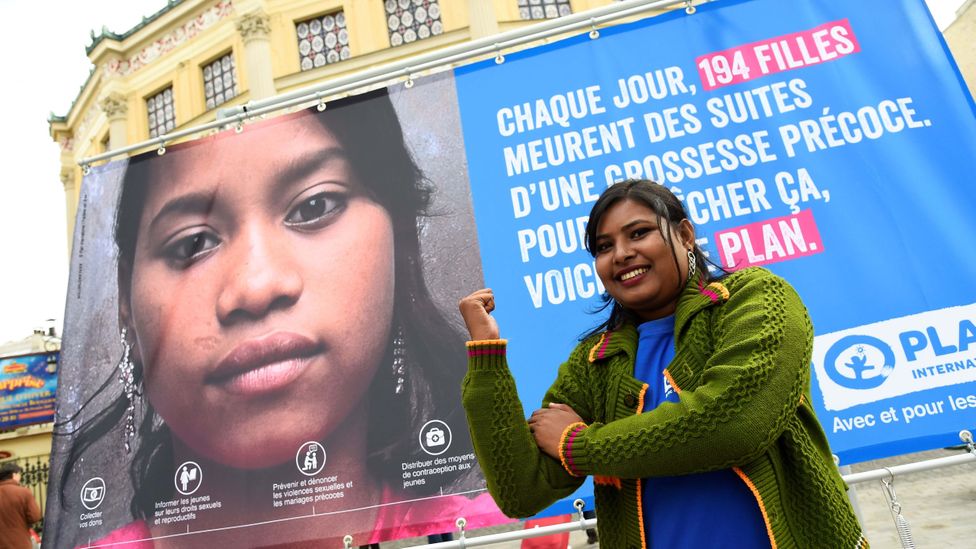
Charity campaigns may be more effective when there are single 'identifiable victims' (Credit: Getty Images)
There's nothing incorrect with using personal stories to raise awareness of a worthy crusade, of course, but the identifiable victim effect does nevertheless siphon billions of dollars away from where information technology could exercise more practiced for a greater number of people. If your goal was to aid every bit many children as possible, a dollar spent on deworming programmes in the developing globe, for instance, would go significantly further than a dollar donated in the United states of america for an expensive medical procedure. It can be fifty-fifty harder to concenter attending to problems that have no identifiable victim at all, such as futurity generations affected by climate change, who do not exist yet.
Extending empathy to abstruse strangers is a particular challenge for the human heed. Originally described by the Stoics thousands of years ago, the concept of "oikeiōsis" describes how our empathy and affinity for others declines by proximity to our lives. Imagine a series of rings: in the bullseye there'due south the self, the innermost ring represents one's family, the adjacent ring i's friends, the next 1'south neighbours, then one's tribe or community, then i'south country, and so on.
The problem, says Blossom, comes when bad actors hijack these "circles of sympathy" to try and sway our behaviours and behavior. Our natural empathy for those closer and more similar to us can exist harnessed to provoke antipathy towards those who are not.
In one report, undergraduates were told near a swain student in the adjacent room, who was in the running for a cash prize in a mathematics contest against another competitor. The undergraduates were given the opportunity to force that competitor to eat distracting hot sauce earlier the contest. When empathy for the student was ratcheted up, by emphasising she was struggling financially, people were more than probable to give a greater dose of hot sauce to her innocent opponent.
Politicians and activists on both sides of the spectrum frequently play to the idea of "us and them", deploying empathy and identifiable victims to brand a political case. It underpins some social media campaigns to "cancel" people, allows immigrants to be demonised, and can even stoke hatred and violence confronting credible outsiders. Lynchings in the US were sometimes motivated by stories of victims affected past the crimes of blackness men, writes Blossom. And as I wrote a few weeks ago, leaders have also manipulated people's natural empathic tendencies to help justify nuclear strikes, arguing that the lives of a million United states soldiers – "our boys" – would be saved by launching diminutive bombs against the Japanese people in a distant country.

Empathy tin be manipulated to amplify antipathy for people who are different (Credit: Getty Images)
A final downside of empathy is its sometimes-incapacitating emotional impact. The philosopher Susanne Langer once called empathy an "involuntary breach of individual separateness" – and this seems to apply peculiarly when nosotros find someone suffering, such as a loved one. Brain browse studies by neuroscientist Tania Vocalizer of the Max Planck Guild in Federal republic of germany accept shown that when people watched others in hurting, their brain activity in the regions associated with pain was partially mirrored. This may be an evolutionary adaptation to help the states predict, and avert, how pain would bear on the states.
"While shared happiness certainly is a very pleasant land, the sharing of suffering tin can at times be hard," writes Singer and her colleague Olga Klimecki, a neuroscientist at the University of Geneva. At its worst, people experience "empathic distress", which tin become a barrier to action. Such distress leads to aloofness, withdrawal and feelings of helplessness, and can even be bad for your health, according to Singer and Klimecki. During the pandemic, this sense of empathy fatigue has become of particular concern among care-givers, such as those working in mental health support or hospital doctors and nurses.
So, where does that leave united states of america? Surely feeling no empathy at all is worse? That would make the states closer to psychopathic. These scientists are not suggesting that empathy should exist actively discouraged. There are times when stepping into somebody'south shoes is a necessary outset step towards positive activeness, care and aid for others.
Instead, the inquiry suggests that we ought to first making a clearer distinction between empathy and its credible synonym: "compassion". If empathy is virtually stepping into someone's shoes, compassion is instead "a feeling of concern for some other person's suffering which is accompanied by the motivation to help", according to Singer and Klimecki. To be compassionate, information technology does not mean you have to share somebody's feelings. It is more nearly the idea of extending kindness towards others.
Blossom uses the example of an adult comforting a child who is terrified of a pocket-size, barking dog. The developed doesn't need to experience the child'due south fright to assist. "There tin can exist pity for the child, a desire to make his or her distress go away, without any shared experience or empathic distress," he writes.
Inspired by scanning the brains of Buddhist monks, Singer discovered that it'south possible to foster greater compassion in people, via simple training methods based on mindfulness, where the goal is to feel positive and warm thoughts about others without focusing on vicarious experience. By comparison this training with techniques designed to foster greater empathy, she and colleagues establish that information technology reduces the effects of empathic distress and makes people more likely to exist motivated to aid others.
So, to return to the hurt feelings of Barry that we started with: it's non necessary for his friend Kari to empathetically feel his pain near his football match – and information technology may even be bad for her. But a dose of compassion? Even for cartoon rectangles, that would go a long way.
* Richard Fisher is a senior journalist for BBC Future. Twitter: @rifish
--
Join 1 one thousand thousand Hereafter fans past liking usa on Facebook , or follow us on Twitter or Instagram .
If you liked this story, sign up for the weekly bbc.com features newsletter , called "The Essential List". A handpicked selection of stories from BBC Future , Civilisation , Worklife , and Travel , delivered to your inbox every Friday.
Source: https://www.bbc.com/future/article/20200930-can-empathy-be-bad-for-you

Kommentar veröffentlichen for "Empathetic People Can Read Minds and Know When You're Lying Meme"